The Architecture Decisions That Cost Startups $500K
Share this blog:
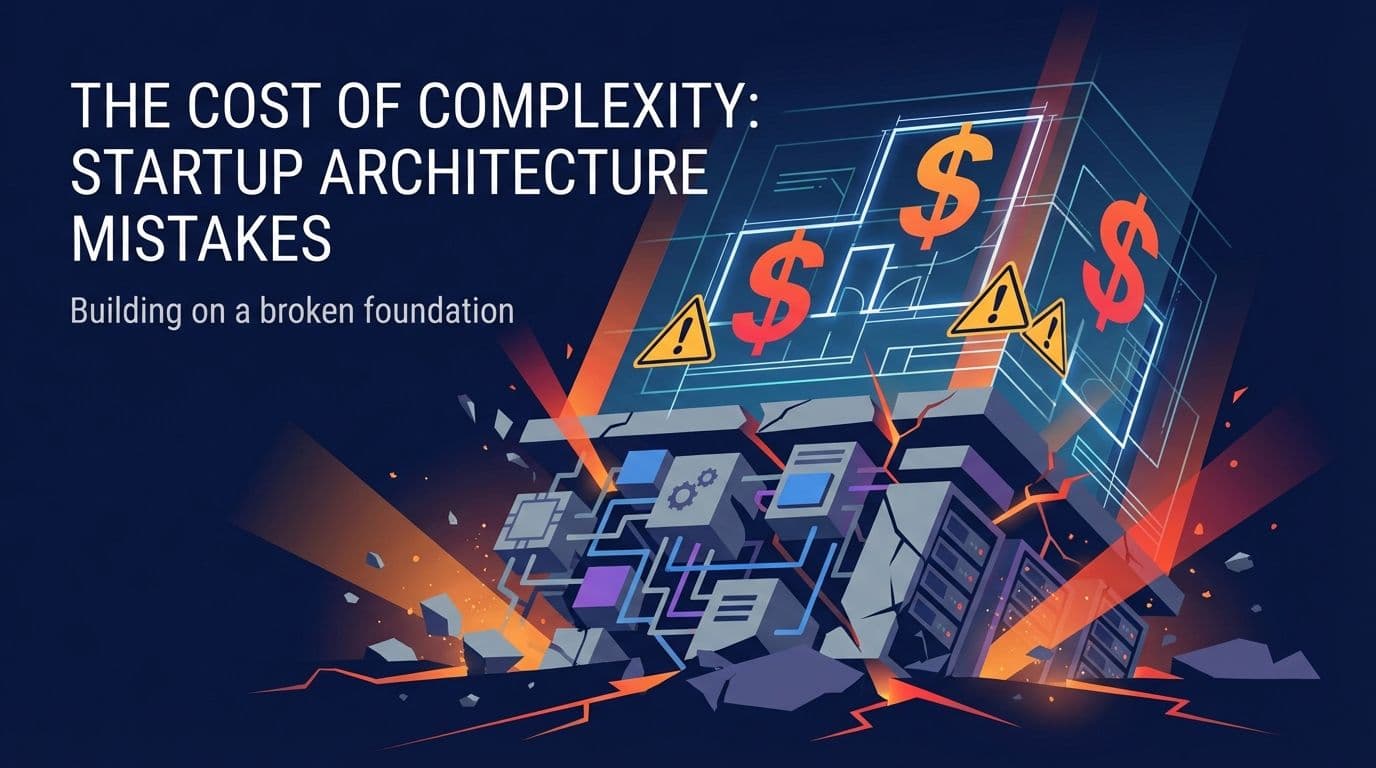
Every startup makes architecture mistakes. That's expected — you're optimizing for speed, not perfection. But some mistakes are $5K to fix and some are $500K. The difference is usually one decision made in week 2 that nobody revisited until month 18.
After auditing 20+ startup codebases across e-commerce, fintech, and SaaS, the same patterns keep showing up. Here are the five most expensive ones.
1. Choosing Microservices Before You Have Product-Market Fit
Cost to undo: $100-200K in re-architecture. 3-6 months of lost velocity.
I see this constantly. A 3-person team building 8 microservices because "Netflix does it." Netflix has 2,000 engineers. You have 3. You don't have a distributed systems problem — you have a product discovery problem.
Start with a well-structured monolith. Use modules and clear boundaries. When a specific module needs to scale independently — and you can articulate exactly why — extract it. That's it.
2. No Database Migration Strategy from Day One
Cost to undo: $50-100K in data migration and downtime. Weeks of careful production migrations.
Raw SQL queries scattered across 200 files. No migration tool. Schema changes done by hand in production. I've seen it at companies with $10M in revenue.
Set up Prisma, Drizzle, or even plain SQL migrations on day one. It takes 30 minutes. Skipping it creates a $100K problem by month 12.
3. Building Auth from Scratch
Cost to undo: $75-150K in security remediation and re-implementation. Plus the breach risk.
"We'll just use JWT and bcrypt, how hard can it be?" Famous last words. Password reset flows, session management, MFA, OAuth providers, rate limiting on login, account lockout, token rotation — auth is an iceberg. The login form is 10% of the work.
Use Clerk, Auth0, or Supabase Auth. If you're in fintech or healthcare with compliance requirements, use a managed identity provider and focus your engineering time on your actual product.
4. Skipping Observability Until the First Outage
Cost to undo: $50-100K in lost revenue from extended outages, plus the retroactive instrumentation effort.
No structured logging. No error tracking. No alerting. console.log in production. Then the app goes down at 2am on a Saturday and nobody knows why for 4 hours. I've seen e-commerce sites lose $50K in a single outage because there was no monitoring.
Day one: Sentry for errors, Datadog or Axiom for logs, PagerDuty for alerts. $50/month now saves $50K later.
5. Ignoring the 10x Data Growth Problem
Cost to undo: $100-200K in re-architecture. Often requires a full platform rewrite.
Your app works great with 1,000 users. Then you get to 50,000 and queries that took 50ms now take 8 seconds. The product page loads in 12 seconds. Your Stripe webhook handler drops events because it times out.
Every query you write, ask: "What happens when this table has 10 million rows?" Add indexes on foreign keys and frequently-queried columns. Use pagination everywhere. Implement caching for read-heavy endpoints. These aren't premature optimizations — they're table stakes.
The Common Thread
All five of these mistakes share the same root cause: nobody in the room had done this before. Every one of these is a 30-minute conversation with someone who's built and scaled production systems. That conversation would have saved 3-6 months of engineering time.
The most expensive technical decision at a startup isn't which framework to use. It's whether to have experienced technical leadership guiding those decisions from the beginning.

Explore More
Need strategic guidance on your architecture decisions?
I help companies make critical technology choices with confidence — from modernization roadmaps to scalability assessments and build-vs-buy analysis.
Relevant services: Fractional CTO • Technical Advisory
Stay Updated
Get notified about new articles on engineering leadership, Edge AI, and fintech.
Or subscribe via email
Discussion
Questions, corrections, or thoughts? Leave a comment below.
Related Posts
Right-Sizing Your DevOps Stack
Most DevOps problems aren't about tools, they're about people. Stop over-engineering and start shipping with a right-sized stack. This CTO's guide offers practical advice on CI/CD, managed services, and automation that saves time instead of creating more work for your team.

The Week I Stopped Coding: Orchestrating an Army of AI Agents
I've stopped coding, but not building. Orchestrating an army of AI agents now, I see how it echoes enterprise digital transformation and signals a profound evolution for technical leadership.
Why I Chose Next.js 16 for My Portfolio
After building enterprise platforms at Hertz, Wayfair, and Costco, I rebuilt my own site on Next.js 16. Here's why server components, edge rendering, and React 19 won — and what surprised me along the way.